Chapter 6
Multiple-choice questions
1 What is a limitation of traditional NPV in sustainability analysis?
A. It ignores social and environmental impacts
B. It is too complex
C. It uses outdated interest rates
D. It overestimates long term value
2 Why might a project with a low IRR still be pursued under integrated rules?
A. It reduces taxes
B. It improves executive bonuses
C. It has high marketing potential
D. It creates significant social or environmental value
3 What is the purpose of scenario analysis in sustainable investing?
A. To evaluate project performance under different future conditions
B. To predict stock prices
C. To reduce audit costs
D. To simplify financial reporting
4 What is a key benefit of using longer time horizons in investment analysis?
A. Lower interest rates
B. Higher short term profits
C. Easier budgeting
D. Better capture of long term impacts
5 How can companies align investment decisions with their purpose?
A. By focusing only on dividends
B. By integrating purpose into capital allocation criteria
C. By outsourcing sustainability
D. By reducing stakeholder engagement
6 What is NOT a problem of the payback rule?
A. Cash flows after the payback period are not incorporated
B. The prespecified payback period is usually arbitrarily decided
C. The payback rule does not use discount rates
D. The size of cash flow is not taken into consideration
7 Using the IRR rule, when should a company take an investment opportunity?
A. If the IRR is lower than the discount factor
B. If the IRR equals the opportunity cost of capital
C. If the IRR exceeds the cost of capital
D. If the IRR leads to a positive NPV
8 What is the IRR of the project?
A project requires $200.000 investment to produce $100,000 in cash flow at the end of year 1, and $250,000 at the end of year 2. After year 2 the project is terminated. The appropriate interest rate is 15%. What is the IRR of the project?
A. 25.23%
B. 28.45%
C. 35.43%
D. 39.56%
9 Which is NOT a type of PV approach?
A. Constrained PV
B. Expanded PV
C. Internalised PV
D. Standard NPV
Open ended questions
1 What is the main critique of traditional investment decision rules like NPV and IRR in this chapter?
2 How do the authors propose integrating sustainability into investment decision making?
3 What is the role of the integrated NPV in sustainable finance?
4 Why might a project with a negative traditional NPV still be considered valuable under integrated decision rules?
5 What is the difference between financial materiality and double materiality in investment decisions?
6 How can scenario analysis support sustainable investment decisions?
7 How can companies ensure consistency in applying integrated investment rules?
8 What is the role of time horizons in evaluating sustainable investments?
9 Why is it important to align investment decision rules with corporate purpose?
10 Name the two main categories of internal errors and explain what they entail and how they are distinguished.
Open ended calculation questions
Questions 1 & 2: NPV of a project
Suppose you have the opportunity to invest €4,000 into a solar panel project today. At the end of year 1 you receive a cash flow of €800, in year 2 of €1,400 and in year 3 €2,800.
1 If the appropriate discount rate for your project is 5%, should you invest in this project according to the net present value (NPV)?
2 What is the implicit assumption behind question 1?
Questions 3 & 4: IPV of a project
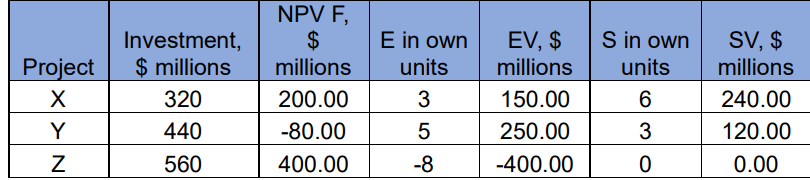
3 What is the integrated present value (IPV) of each project (assuming equal weights between FV, EV and SV)?
4 What would be the considerations for choosing between the projects?
Questions 5 to 8
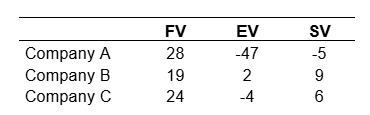
Companies A, B and C have the following value creation profiles, where each value represents the present value of expected value flows:
5 Which of the three companies has the highest financial value?
6 Which of the three companies has the highest integrated value?
7 The futureproofing ratio (FR) equals IV/FV. Please calculate futureproofing ratios for the three companies.
8 Which of the three companies has the steepest transition challenge? Why?
Case study infrastructure investment in transition
This case examines how a global, publicly listed infrastructure company integrates sustainability into its investment decisions. While committed to reducing greenhouse gas (GHG) emissions through tools like an internal carbon price and GHG investment budget, the company also seeks to maintain shareholder value. A key decision involves converting fossil fuel assets into renewable infrastructure. An initial net present value (NPV) analysis suggests the project is unviable, but the CFO challenges this, citing long-term risks of asset stranding. A revised analysis reveals a positive NPV, highlighting how sustainability considerations can reshape financial outcomes and strategic thinking.
Inward vs outward materiality
In times of transition, the concepts of inward and outward materiality are increasingly relevant to investment decision-making. Inward materiality refers to how environmental and social issues affect a company’s financial performance, while outward materiality considers how a company’s operations impact the environment and society. These two dimensions are deeply interconnected: a company’s environmental footprint can influence its regulatory exposure, brand value, and long-term viability, which in turn affect shareholder returns.
Navigating and balancing goals
This dynamic is particularly relevant for a global infrastructure company listed on a stock exchange. Such a company must balance its fiduciary duty to manage shareholder value with its strategic goal of materially reducing greenhouse gas (GHG) emissions. To this end, it has implemented an internal carbon price and a GHG investment budget. However, it is still exploring how to integrate other concerns such as human rights and biodiversity into its investment framework.
Investment decision analysis
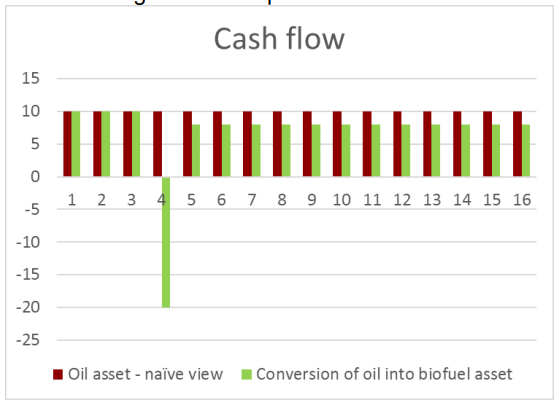
A recent investment decision illustrates the complexity of integrating sustainability into financial analysis. The company is considering the conversion of a set of fossil fuel assets into renewable energy infrastructure. For that purpose, the Chief Financial Officer (CFO) requested a traditional net present value (NPV) analysis from the finance team. The results were discouraging: the NPV was negative, primarily due to a significant capital outlay required in year four and the expectation of lower operating margins from the renewable asset compared to the existing fossil fuel operations. See the illustrative cash flow pattern below:
Shifting perspective
At first glance, the decision seemed straightforward—retain the fossil fuel assets and avoid a value-destroying investment. However, the CFO challenged this conclusion. He argued that the high margins currently enjoyed by the fossil fuel assets are not sustainable in the long term. Regulatory pressures, market shifts, and societal expectations are likely to render these assets stranded, eroding their residual value. In other words, the initial NPV analysis failed to account for the inward materiality of climate risk.
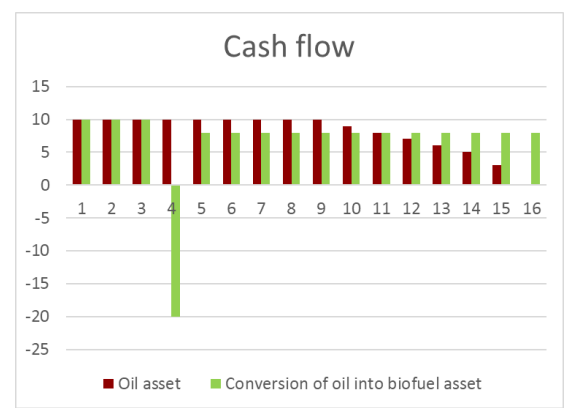
Prompted by this insight, the finance team revised their analysis. The revised cash flow analysis looked like the one below:
This time, they incorporated assumptions about the declining value of fossil fuel assets. The updated NPV was positive, despite the upfront investment and lower margins. The key driver of this improved outlook was the longer-term viability and resilience of the renewable asset, which aligns with both the company’s GHG reduction goals and its financial sustainability.
Optionality
Moreover, the revised analysis did not even account for the optionality of future renewable developments in the same area—an upside that could further enhance the project's value. This highlights another critical aspect of sustainable investing: the strategic value of flexibility and future-proofing in a rapidly changing regulatory and market environment.
Shifting methods
Looking ahead, the company faces the challenge of embedding similar considerations for human rights and biodiversity into its investment framework. This will likely require new metrics, stakeholder engagement, and scenario analysis to understand how these outward material impacts could translate into inward financial risks or opportunities.
Conclusion
In conclusion, this case illustrates how sustainability considerations—when properly integrated—can shift investment decisions and reveal hidden value. It also demonstrates the evolving role of finance professionals in navigating the intersection of sustainability performance and financial performance. As companies face increasing pressure to align with global sustainability goals, the ability to incorporate both inward and outward materiality into investment decisions will be a critical capability for long-term success.
Case questions
1 How do inward and outward materiality interact in this case? Can you think of other examples where outward impacts (e.g., human rights) could become inward risks?
2 What frameworks or tools could the company use to begin integrating human rights and biodiversity into its investment decisions? Are there industry best practices or standards to follow?
3 What does the CFO’s challenge to the initial NPV analysis reveal about leadership in sustainability transitions?
4 How can finance teams be better equipped to incorporate ESG considerations into their analyses? What skills, tools, or organizational changes might be needed?
5 What role does asset longevity play in sustainable investment decisions? How can it be quantified and communicated to stakeholders?
Additional questions
1 Why would companies apply an internal carbon price? What are the benefits and limitations of this approach?
2 What are the risks of relying solely on traditional NPV analysis when evaluating sustainability related investments? How can these risks be mitigated?
3 How can companies account for the risk of asset stranding in their investment decisions? What indicators or scenarios should be considered?
4 How important is executive mindset in driving sustainability integration?
5 What kind of top down initiatives can the CFO and other executives take to speed up the integration of sustainability considerations in financial analysis?
6 What role do you see for bottom up initiatives?
7 How should companies value optionality in sustainability investments, such as the potential to build additional renewable assets nearby?
8 Should this be included in the NPV, or treated separately?
9 How might investors and other stakeholders react to a decision that appears financially marginal in the short term but is justified by long term sustainability goals?
10 How should the company communicate such decisions?