Chapter 51
Multiple-choice questions
1 Why is monetizing social and environmental value useful?
A. To reduce taxes
B. To compare impacts with financial performance
C. To increase marketing budgets
D. To avoid regulation
2 Which of the following best describes a shadow price?
A. The market price of a product
B. The cost of internal operations
C. The price of intangible assets
D. A hypothetical price for an externality
3 What is a key challenge in calculating social value?
A. Lack of standardized metrics
B. Too much financial data
C. Overregulation
D. High profit margins
4 Which of the following is an example of an external impact?
A. Air pollution affecting nearby communities
B. Employee training costs
C. Office rent
D. Shareholder dividends
5 What principle helps companies decide which impacts to measure?
A. Efficiency
B. Liquidity
C. Materiality
D. Profit maximization
6 How can companies improve the credibility of their impact valuations?
A. Apply transparent, standardized methodologies
B. Avoid third party audits
C. Focus only on positive impacts
D. Use internal estimates only
7 What is NOT true regarding materiality?
A. Materiality looks at all potential impacts on people and environment
B. Materiality of issues changes over time
C. Materiality of issues differs by country and industry
D. Labour practices and business ethics are always material
8 What is not included in the definition of impact according to the Impact Economy Foundation (2022)?
A. A breach of a right
B. A change in capital
C. A change in experienced wellbeing
D. A change in resource scarcity
9 Assuming a company has a revenue of €200 million and an estimated consumer surplus of €60 million. What would be the price elasticity of demand?
A. 0.15
B. 1.33
C. 1.67
D. 3.33
10 Determining value streams involves both measurement and estimation. In which of the situations below is measurement often sufficient and you don't need to estimate?
A. Historical CO2 emissions only
B. Historical CO2 emissions and historical shadow prices
C. Historical CO2 emissions and historical shadow prices and future CO2 emissions
D. Historical CO2 emissions and historical shadow prices and future CO2 emissions and future shadow prices
Open ended questions
1 What is the main purpose of calculating social and environmental value in corporate finance?
2 How do the authors define “impact” in the context of corporate activities?
3 Why is monetization of social and environmental impacts important?
4 What are some challenges in monetizing non financial impacts?
5 How do shadow prices help in calculating environmental value?
Open ended calculation questions
Question1
A company captures 2 million tons of carbon last year (meaning it took the CO2 out of the environment, which is positive), and grows this amount by 6% per year. The current shadow carbon price is €150 per ton and will increase by 10% each year. Assuming this is the company’s only environmental impact, what is the environmental value flow of the company in 8 years?
Questions 2 to 6
The table below gives financial and environmental data on a project:
2 Calculate environmental value flows.
3 Calculate total value flows.
4 Calculate financial value, taking 2026 as the current year, and fill in the gaps in the table below.
5 Calculate environmental value, taking 2026 as the current year, and fill in the gaps in the table below.
6 Calculate the integrated value of the project.
Questions 7 to 9
The following data and assumptions are given for Unilever’s biodiversity damage in 2023:
• 4 million hectares of land used for Unilever’s production
• Mean species abundance (MSA) loss per hectare: 0.4
• Damage happens across the value chain and is 50% attributable to Unilever
• Price per unit of damage: EUR 3294
7 What is the value flow of biodiversity loss attributable to Unilever in euro billions?
8 Assuming a social discount rate of 2.2% and constant value flows into eternity, what is the value of biodiversity loss attributable to Unilever?
9 The calculation in question 8 is quite simplistic. Please give reasons why the actual damage might be higher or lower than estimated above.
Mini case study Lufthansa
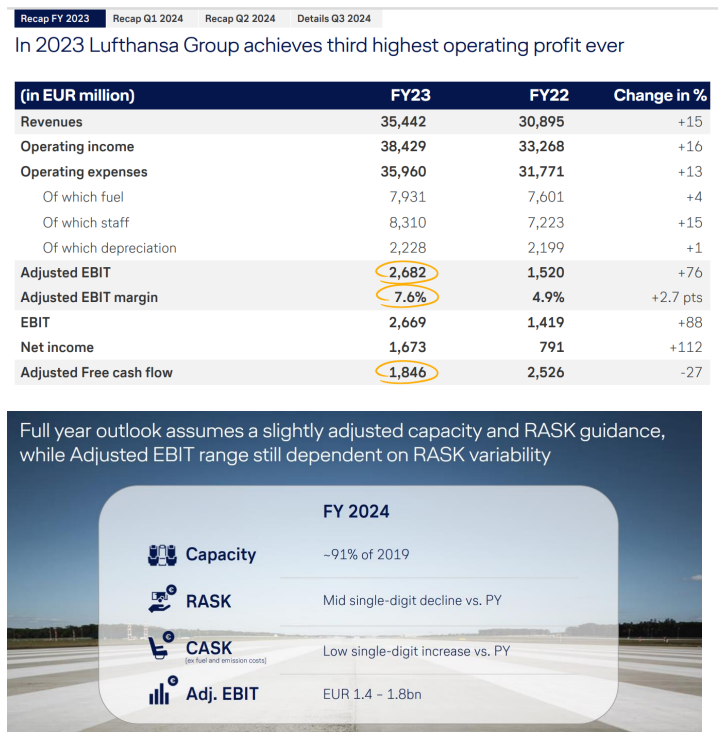
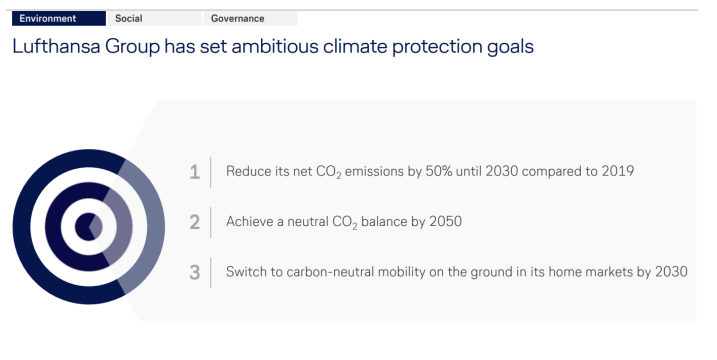
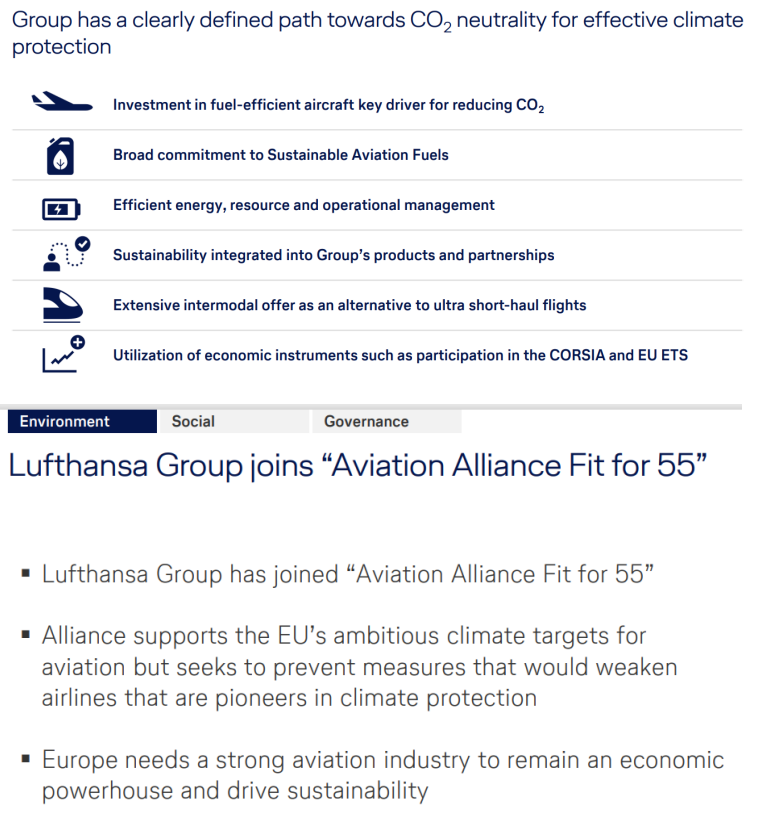
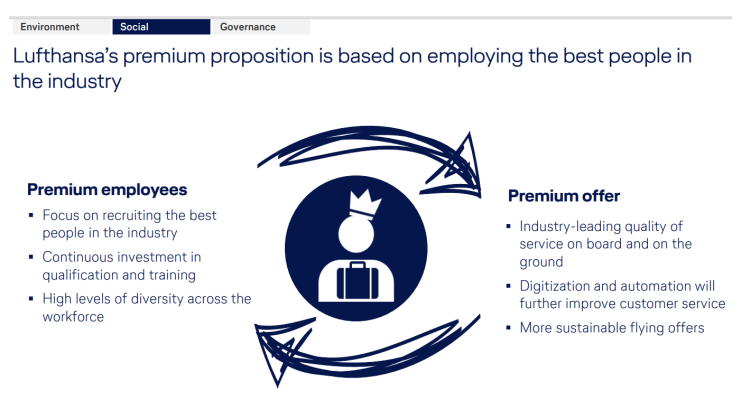
See the slides below from two presentations by airline Lufthansa for investors. Go through these briefly before answering the questions.
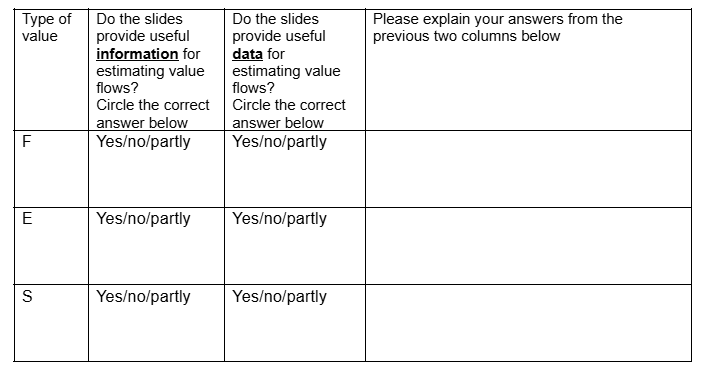
1 Indicate the extent to which you can calculate or estimate Lufthansa's value flows based on this presentation. Follow the structure of the matrix below and indicate with bullets, first for F, then for E and then for S:
• Is there useful information for estimating value flows: yes/no/partly
• Are there any useful data for estimating value streams: yes/no/partial
• Substantiation of the two above bullets
2 In which quadrant of the value window do you think Lufthansa is located? Explain.
3 Describe two routes that Lufthansa can take within the value window and explain them both.