Chapter 4
Multiple-choice questions
1. What is the main critique of using traditional discount rates for sustainability projects?
A. They are too complex to calculate
B. They are not accepted by financial institutions
C. They overestimate future cash flows
D. They undervalue long-term social and environmental benefits
2. What does a social discount rate aim to reflect?
A. Corporate tax rates
B. Inflation expectations
C. Intergenerational equity and societal preferences
D. Market volatility
3. How do high discount rates affect sustainability investments?
A. They make them more attractive
B. They reduce their present value and discourage investment
C. They increase stakeholder engagement
D. They improve ESG ratings
4. Which of the following best describes the authors’ view on discounting future generations’ welfare?
A. It is economically efficient
B. It is ethically problematic and should be reconsidered
C. It is necessary for profitability
D. It aligns with shareholder interests
5. What does the 'time value of money' imply?
A. Money loses value over time due to inflation
B. People prefer money in the future over money today
C. Money today is worth more than the same amount in the future
D. Interest rates are always positive
6. What is the formula for the present value (PV) of a perpetuity?
A. 𝑃𝑉 = 𝐶𝐹 (1+𝑟) 𝑛
B. 𝑃𝑉 = 𝐶𝐹. (1 + 𝑟) 𝑛
C. 𝑃𝑉 = 𝐶𝐹 𝑟
D. 𝑃𝑉 = 𝐶𝐹. 𝑟
7. Which of the following statements best describes the 'law of one price'?
A. All goods must be sold at the same price globally
B. Identical goods should sell at the same price in efficient markets 25
C. Prices are determined by central banks
D. Arbitrage is illegal in efficient markets
8. What is the main reason social discount rates are lower than financial discount rates?
A. Higher inflation expectations
B. Equal treatment of future generations
C. Higher opportunity cost
D. Greater liquidity
9. What does the term 'opportunity cost of capital' refer to?
A. The cost of issuing new equity
B. The return on the safest investment
C. The best available return on an investment with a similar risk
D. The average market return
10. Which of the following is a component of the social discount rate in the Ramsey formula?
A. Liquidity premium
B. Credit spread
C. Time preference
D. Corporate tax rate
11. What happens to the NPV of a bond when the yield is lower than the coupon rate?
A. NPV is zero
B. NPV is negative
C. NPV is positive
D. NPV equals the bond price
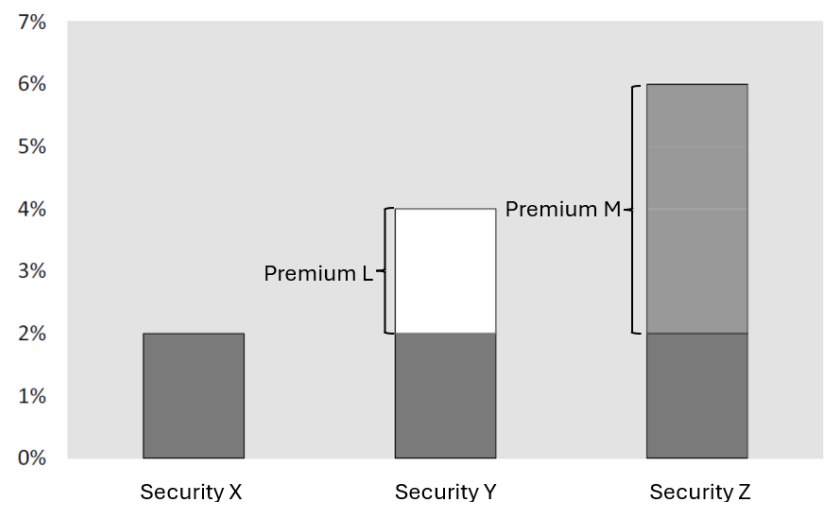
12. Consider the below picture (adapted from page 103 of the book): which of the below statements is true?
A. Premium L is the corporate bond premium
B. Security Z is a government bond
C. The benchmark rate is 4%
D. The equity risk premium is 6% 26
13. Why are social discount rates typically low?
Open-ended questions
Why do the authors argue that traditional discount rates may not be suitable for long-term sustainable investments?
How does the chapter propose adjusting discount rates to better reflect long-term value creation?
What is the difference between a financial discount rate and a social discount rate?
How can discount rates influence corporate decision-making on sustainability projects?
Explain the concept of the time value of money.
Why do corporate bonds typically have higher yields than government bonds?
What is meant by the 'one discount rate fits all' heuristic?
How does compounding affect the future value of an investment?
What is the impact of environmental liabilities on the integrated discount rate?
How can a company reduce its integrated cost of capital?
What is the difference between an annuity and a perpetuity?
Different types of securities have different magnitudes of interest rates. Which one would be the highest in a developed market, for a profitable company: equity, corporate bonds or government bonds?
Open ended calculation questions
Guidance: If not mentioned, please use the compounding interest formula for PV calculation
Compute the future value of €300 in one, three and five years, for both simple interest and compounding interest, assuming an interest rate of 2.5%.
Compute the future value of €3500 in one, three and five years, for both simple interest and compounding interest, assuming an interest rate of 7%.
Compute the present value now of €5000 to be received in 8 years, assuming an interest rate of 6%.
Compute the present value now of €5000 to be received in 15 years, assuming an interest rate of 2%.
Compute the net present value of the following series of cash flows, discounted at 4%.
a) €1000 at t=0
b) €500 at t=1
c) €1,000 at t=2
d) €1,500 at t=3
e) €1,000 at t=3Compute the present value of an annuity of €5,000 for each of the next five years at a discount rate of 6%.
Compute the present value of an annuity of €1,000 for each of the next 15 years at a discount rate of 3.5%.
Compute the present value of an annuity of €50,000 spread equally over the next ten years at a discount rate of 10%.
The German government is offering a five year bond with a 5% coupon rate. Please visualise its cash in and outflows.
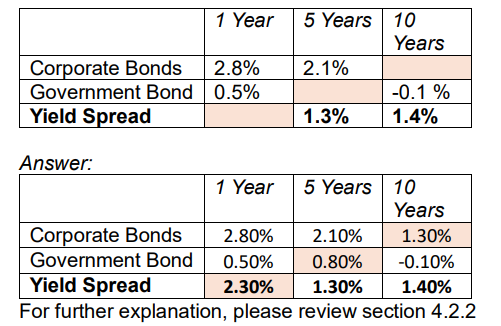
Please fill the gaps in the following yield table.
11. Please compute the social discount rate, based on a growth rate of 1.3%; a time preference of 0%; and Elasticity of 1.5
Questions 12-14
The below integrated balance sheet is partly filled in.
Question 12. Calculate the integrated cost of capital with the data on the right-hand side of the balance sheet
Question 13. Calculate the cost of capital of F net operating assets
Question 14. Calculate the integrated cost of capital with the data on the left-hand side of the balance sheet