Chapter 31
Multiple-choice questions
1. What is the primary goal of corporate governance in the context of this chapter?
A. Maximizing quarterly earnings
B. Aligning corporate behavior with long-term value creation
C. Avoiding regulatory scrutiny
D. Reducing board meetings
2. Which governance model includes broader societal and environmental considerations?
A. Financial model
B. Managerial model
C. Shareholder model
D. Stakeholder model
3. Why is board diversity emphasized in the chapter?
A. To meet legal quotas
B. To enhance decision-making and reduce groupthink
C. To improve marketing strategies
D. To reduce board size
4. How should executive compensation be structured to support sustainability?
A. Based solely on stock price
B. Based on peer company bonuses
C. Linked to long-term performance of social, financial and environmental value
D. Paid entirely in cash
5. Which of the following is a governance tool for sustainability accountability?
A. Quarterly earnings calls
B. Integrated reporting
C. Stock buybacks
D. Tax optimization strategies
6. Which of the following broad statements about corporate governance issues is false?
A. Corporate governance must consider non-financial factors.
B. The core problems of corporate governance aggravate one another.
C. The amount of debt does not impact the main corporate governance problems.
D. Information asymmetry can be addressed by social and ecological reporting.
7. What is one of the positive implications of the shareholder model?
A. Simplifies decision-making as value is only maximised for one stakeholder.
B. Primarily prevents future losses by considering its wider impact. 20
C. Shareholder structure tends to be rigid, allowing for easier planning.
D. All of the above.
8. Which of the following is true for the shareholder model?
A. The main objective of the company is to maximise value for all stakeholders.
B. Managers might be encouraged and personally incentivised to engage in short-termism.
C. Interests of bond- and shareholders are equally balanced.
D. Its impact on non-financial stakeholders tends to be negligible.
9. How does the stakeholder model differ from the shareholder model?
A. It integrates the interest of social agents, such as employees and consumers.
B. The key stakeholder becomes the government.
C. Only the value for social agents should be maximised.
D. All of the above.
10. How does governance impact the valuation of a company?
A. Corporate governance does not impact traditional valuation models, such as multiples or the DCF.
B. It purely impacts the integrated value of the company, not the financial value.
C. Strong governance reduces the risk of a firm and accordingly its cost of capital.
D. Bad governance reduces the cost of debt.
11. Which of the following are not common owners of private companies?
A. Families
B. Foundations
C. Hedge Funds
D. Private Equity A
12. Which of the following is true about board mechanisms to foster stakeholder interests?
A. The different components should be tackled independently by companies.
B. Board member composition should mainly focus on age, gender and ethnicity.
C. Financial incentivisation does not affect ecological decision-making.
D. Sustainable responsibility of boards should ideally be incorporated in the company charter.
13. How can the future design concept impact the sustainability of corporate activity?
A. It states that firms must directly involve future stakeholders.
B. Through the view of “imaginary future persons”, people can change inflexible points of view.
C. Company boards should be staffed to emphasise future ecological performance.
D. Business models must be designed by considering prevailing wider challenges.
14. What does the concept of tunnelling relate to in the financial sense?
A. Circumvent regulation to increase financial performance.
B. Majority shareholders unfairly claiming assets at the expense of minority shareholders. 21
C. The practice of institutional investors removing unperforming managers.
D. The agency problem where managers focus on their personal benefit at the expense of the company.
Open-ended questions (with brief answer keys)
1. How do the authors define the role of corporate governance in the context of longterm value creation?
2. What are the key differences between shareholder and stakeholder models of governance discussed in the chapter?
3. Why is board diversity important in corporate governance, according to the authors?
4. How can executive compensation be aligned with long-term value creation?
5. What governance mechanisms are suggested to ensure accountability in sustainability performance?
Open-ended calculation questions
Questions 1-5
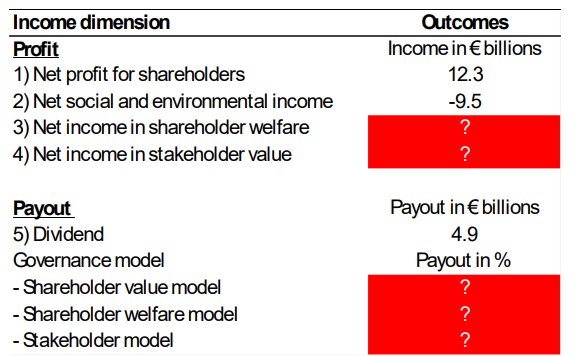
The table below gives performance data for fictious stock listed company.
Adapted from: Schoenmaker, D., & Schramade, W. (2024). Shareholder primacy or stakeholder governance?. Finance Research Letters, 69, 106244.
Please answer the following questions based on the above table.
Question 1. If you assume that the shareholder welfare model applies a small weight for externalities of 0.2, then what is 3) net income in shareholder welfare?
Question 2. What is 4) net income in stakeholder value?
Question 3. What is the payout % in the shareholder value model?
Question 4. What is the payout % in the shareholder welfare model?
Question 5. What is the payout % in the stakeholder value model?
Questions 6-11
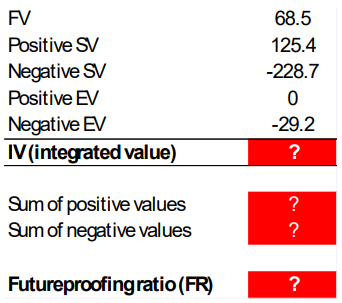
The table below gives key data points on Heineken from the AEX Futureproof report:
Please answer the following questions based on the above table.
Question 6. What is the integrated value of Heineken?
Question 7. Reflect on the outcome of question 1: what does it imply?
Question 8. Derive both the sum of positive values and the sum of negative values and link them to integrated value
Question 9. The negative social value of Heineken is due to the high social costs of alcohol. What can Heineken do to reduce the damage? What dilemma does it face?