Chapter 11
Multiple-choice questions
1. Which model considers social and environmental value only to the extent that they affect financial value?
A. Enlightened / refined shareholder model
B. Integrated model
C. Shareholder model
D. Stakeholder model
2. Which of the following is a direct driver of biodiversity loss?
A. Corporate taxation
B. Inflation
C. Overexploitation of resources
D. Urban planning
3. What is the main goal of the UN Sustainable Development Goals (SDGs)?
A. Guide the transition to a sustainable and inclusive economy
B. Increase global GDP
C. Promote military cooperation
D. Reduce corporate taxes
4. What is the main critique of the stakeholder model mentioned in the chapter?
A. It ignores environmental concerns
B. It is too focused on shareholders
C. It leads to excessive profits
D. It may reduce pledgeable income and create managerial confusion
5. What is the main purpose of the planetary boundaries framework?
A. To define a safe operating space for humanity
B. To measure GDP per capita
C. To promote economic growth
D. To regulate international trade
6. Which of the following is NOT one of the nine planetary boundaries?
A. Air traffic emissions
B. Climate change
C. Land-system change
D. Ocean acidification
7. What is the role of shadow pricing in integrated value calculations?
A. To assign monetary value to social and environmental impacts
B. To calculate tax liabilities
C. To estimate the market value of intangible assets
D. To hide costs from regulators
8. Which of the following is an example of a novel entity in the planetary boundaries framework?
A. Carbon dioxide
B. Methane
C. Nitrogen
D. Plastics
9. What does the concept of resilience refer to in socio-ecological systems?
A. The ability to adapt to shocks and maintain function
B. The ability to maximize growth
C. The capacity to resist shocks
D. The speed of recovery
10. Which of the following is wrong about the current linear production and consumption system?
A. They assume ongoing availability of natural resources.
B. Natural resources are considered as cheap.
C. They do not consider the waste element of the production cycle.
D. Usage of renewable resources is still a significant part of the system.
11. What is the purpose of the planetary boundaries framework?
A. Defines the limits in nine areas of the planet which humanity must not exceed to maintain a liveable planet.
B. Outlines the maximum GDP levels beyond which climate change will be irreversible.
C. Shows the amount of import / export that a country should not exceed, to protect domestic companies.
D. Indicates the annual date when the earth’s yearly resources have been exhausted.
12. Which of the following is true about the SDGs?
A. They are all independent of one another.
B. Their overall goal is to strengthen trans-national partnerships for ensuring fair development
C. They emphasise environmental goals.
D. Their goals only aim to better the lives the population in third-world countries.
13. Which of the following models does not set financial value equal to all other parameters in the model?
A. Shareholder model
B. Refined shareholder model
C. Stakeholder model
D. Integrated model
14. How does traditional corporate finance view ethics?
A. It argues that business and ethics are separated.
B. Social considerations have always been a focus of corporate finance, unlike ecological concerns.
C. Corporate managers should not be trained to purely consider financial metrics.
D. Businesses should support the government in addressing wider concerns.
15. Which of the following is primarily a financial concept??
A. Linear production and consumption system
B. Corporate Governance
C. External Impacts
D. Resilience of a system
Open-ended questions
1. Explain the concept of integrated value (IV) and how it differs from traditional financial value.
2. What are planetary boundaries, and why are they important for corporate decisionmaking?
3. Describe the main social challenges highlighted in the chapter and how they relate to long-term value.
4. How does the enlightened/refined shareholder model attempt to incorporate sustainability into corporate finance?
5. Discuss the implications of the Deepwater Horizon oil spill and the Rana Plaza collapse for corporate responsibility.
6. What role do the UN Sustainable Development Goals (SDGs) play in guiding corporate strategy?
7. Compare and contrast the shareholder, stakeholder, and integrated models of corporate finance.
8. How can companies integrate social and environmental externalities in their financial models?
9. What are some of the challenges in measuring social and environmental value in monetary terms?
10. Why is a system perspective important when addressing sustainability in corporate finance?
11. How are the planetary boundaries (PBs) relevant for companies?
12. A chemicals company is considering an international expansion. Give an example of a planetary boundary that might impact this decision.
Open-ended calculation questions
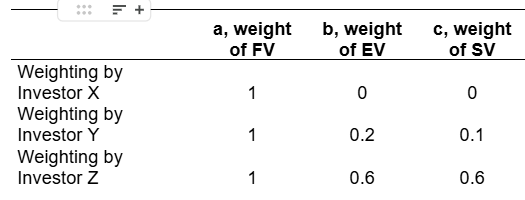
Suppose institutional investors X, Y and Z have the following parameters for weighing the types of value:
1 Please classify institutional investors X, Y and Z based on those parameters.
2 Calculate the IV assessments of institutional investors X, Y and Z for companies A, B and C.
3 Which companies will institutional investors X, Y and Z prefer to invest in, all else equal, e.g. assuming correct market valuations?