Chapter 21
Multiple-choice questions
1. What does integrated value (IV) consist of?
A. Financial value and environmental value
B. Financial value and social value
C. Financial value, social value, and environmental value
D. Only financial value
2. What is the main purpose of internalisation in value creation?
A. To eliminate competition
B. To increase shareholder profits
C. To increase taxes
D. To shift external costs back to companies and consumers
3. Which quadrant in the Value Creation Matrix represents win–win scenarios?
A. Quadrant 1, top left
B. Quadrant 2, top right
C. Quadrant 3, bottom left
D. Quadrant 4, bottom right
4. Which of the following is NOT a driver of internalisation?
A. Licence to operate
B. Regulation and taxation
C. Stock market speculation
D. Technological advancement
5. According to the book, what is the key challenge with current corporate reporting regarding SV and EV?
A. It is only available to investors
B. It lacks standardisation and visibility
C. It is too detailed
D. It is too expensive
6. What does the concept of double materiality refer to?
A. Financial and operational risks
B. Internal and external audits
C. Inward and outward impacts between companies and society/nature
D. Tangible and intangible assets
7. What is the formula for Expected Transition Loss (ETL)?
A. ETL = a × b × c
B. ETL = b × V × PT × (1 - a)
C. ETL = FV × SV × EV
D. ETL = FV - EV + SV
8. Which of the following is typically NOT a key component of a business model?
A. Customer value proposition
B. Key resources and processes
C. Profit formula
D. Stakeholder voting rights
9. What does integrated value creation aim to achieve?
A. Aligning business goals with taxation needs
B. Creating financial, social, and environmental value
C. Maximizing the sum of profits and environmental value
D. Outsourcing sustainability to third parties
10. When does a company generate economic profits?
A. If its ROIC exceeds its WACC.
B. If its ROIC equals its WACC.
C. If its ROIC is less than its WACC.
D. If its ROE exceeds its WACC.
11. A firm that creates social value and environmental value, but destroys financial value, would according to the value window be characterised as...
A. Overexploitation
B. Collapse
C. Win-Win
D. Charity
12. Which of the following statements is wrong regarding the quantification of IV?
A. Quantifying social and ecological costs has become more difficult compared to the past.
B. The number of material issues varies across companies, partly depending on their industry.
C. Considering only social or economic value is not sufficient for integrated value.
D. Quantifying integrated value requires a discount rate.
13. What is an issue with a purely financial balance sheet when making integrated investment decisions?
A. Potential intangible resources may not be taken into account.
B. Land and PPE tend to be understated due to valuation of non-current assets.
C. The social value created by retained Earnings is difficult to quantify.
D. Sustainable investments are not reflected. A
Open-ended questions (with brief answer keys)
1. Explain the concept of integrated value creation.
2. Why is internalisation important for sustainable business models?
3. Describe the four quadrants of the Value Creation Matrix.
4. How can scenario analysis help companies prepare for sustainability transitions?
5. What is the role of stakeholder impact maps in integrated value creation?
6. How does the concept of double materiality influence investment decisions?
7. What are the three components of a successful business model according to Johnson et al. (2008)?
8. How can companies quantify environmental value (EV)?
9. What is a transition pathway and why is it important?
10. How does integrated value creation differ from traditional shareholder value maximization?
11. Why is it important for companies to consider planetary boundaries in their strategies?
12. What role do stakeholders play in integrated value creation?
Open-ended calculation questions (with brief answer keys)
Questions 1&2
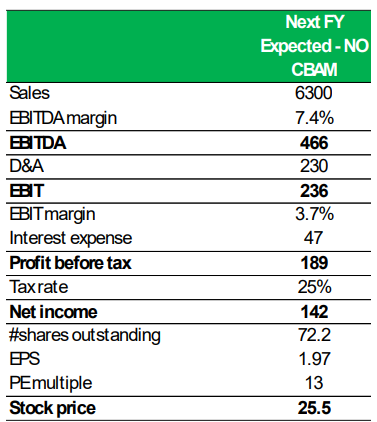
Given below are the market expectations regarding a steel company if there is no carbon border adjustment mechanism (CBAM, i.e., carbon price on imports):
Let’s suppose that if CBAM does go ahead, then:
The expected turnover will be 800 higher
The EBITDA margin increases by 330bps
And the multiple will be 2 points higher
Question 1. What will the new stock price be?
Question 2. If the chance of CBAM going ahead is 20%, then what will the stock price be?
Questions 3-5
CO2 prices may affect profits. For four mining companies, the table below gives some data.
You may assume that the cost price with a CO2 price of all companies equals the cost of the most expensive producer.
Question 3. Please fill in the missing numbers (indicated by question marks)
Question 4. Which company benefits from a higher CO2 price?
Question 5. What happens with percentage profit margins due to the CO2 price?
Question 6
Suppose a company causes an annual biodiversity loss of €1.2 billion. In addition, its annual carbon emissions amount to 20 million tonnes. The applicable shadow carbon price is €100 per tonnes.
Question 6. What is the company’s resulting annual ecological value creation?
Questions 7&8:
Transition losses of an electricity generator An electricity generating utility provider has a value of €100 billion and is financed with €60 billion equity and €40 billion debt. The utility’s power generation is fully based on gas, a fossil fuel. The probability of transition is 80 per cent. The electricity utility has a low adaptation capacity of 30%.
Question 7. What are the expected transition losses of this utility?
Question 8. Will the utility survive?
Question 9-11:
A steelmaker’s transition dilemma Consider a steel company with a value of €120 billion. The steelmaker’s production process is centred around coal, a fossil fuel. The probability of transition from fossil fuels to renewables is 75%. The steel company utility has a low adaptation capacity of 20%. The steelmaker is considering a €40 billion investment in renewable technology to replace the current coal powered production process.
Question 9. Calculate the expected transition losses with the current technology
Question 10. Calculate the expected transition losses with the new technology
Question 11. Should the steelmaker do this large investment?
Case study DEME
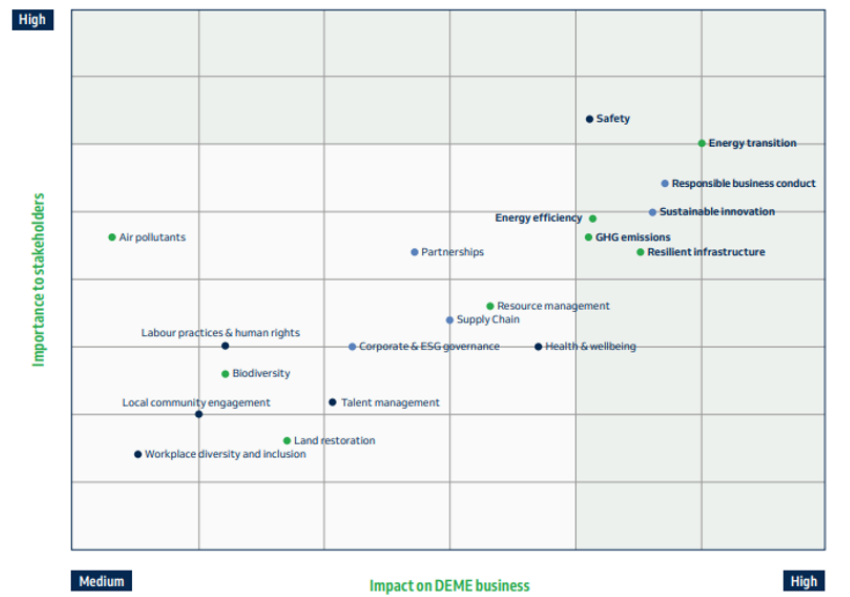
See here the materiality matrix of the Belgian dredging company DEME.
Source: DEME annual report 2024
Choose two of the most material issues and answer the below questions for those two issues at DEME.
Question 1. In what way are those two issues outward material?
Question 2. What are useful indicators for the outward materiality of those issues?
Question 3. In what way are those two issues inward material?
Question 4. In what way could those two issues affect the financial value drivers?